

SREP, or Strategic Research and Extension Plan, is a strategic framework used in agriculture to align research and extension activities with the specific needs and challenges of a region. It serves as a roadmap for agricultural development by conducting needs assessments, prioritizing research efforts, involving stakeholders, generating location-specific technologies, and guiding the dissemination of these innovations. SREPs ensure that public resources are efficiently utilized while fostering collaboration among researchers, extension officers, farmers, and policymakers to enhance agricultural productivity and improve the livelihoods of farming communities.
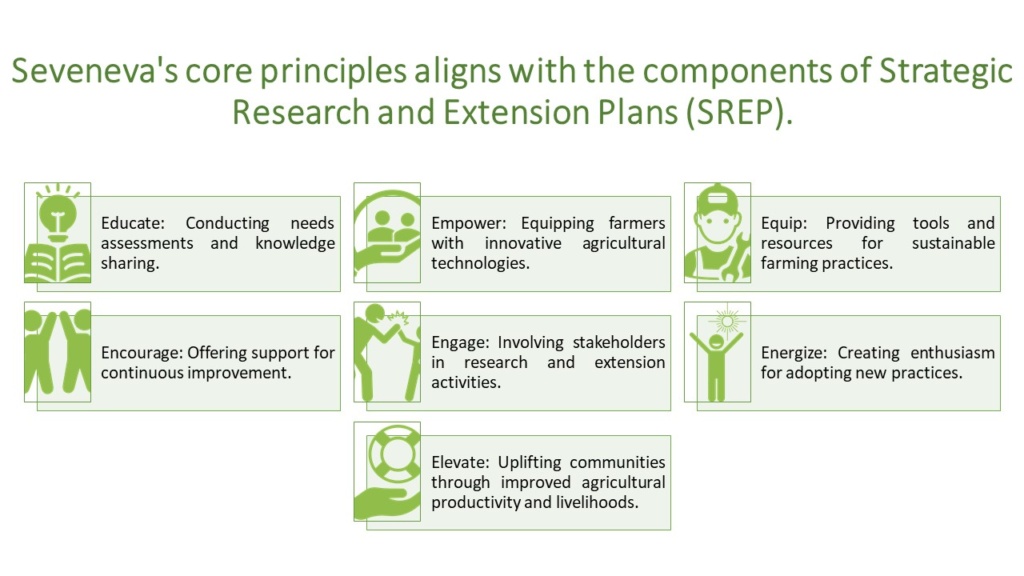
The purpose of a Strategic Research and Extension Plan (SREP) is to:
- Identify specific agricultural needs and challenges in a region.
- Prioritize research and extension efforts for maximum impact.
- Engage diverse stakeholders, including farmers and experts.
- Develop and disseminate region-specific agricultural technologies.
- Adapt strategies based on real-world feedback.
- Monitor and evaluate progress and impact.
- Promote data-driven decision-making.
Overall, SREPs aim to enhance agricultural productivity, sustainability, and the well-being of farming communities.

Optimizing Agricultural Development through Strategic Research and Extension Plans (SREPs)
SREPs play a crucial role in the agriculture sector by guiding the generation and dissemination of relevant technologies. They are instrumental in aligning research and extension efforts with the specific needs of different regions and stakeholders. Here, I'll discuss how SREPs can facilitate the effective generation and dissemination of location-specific agricultural technologies, drawing on field experiences.
Needs Assessment:
SREPs begin with a thorough needs assessment, which involves consultation with local farmers, community leaders, and other stakeholders. This step ensures that the technologies generated are tailored to the specific challenges and opportunities of the region. For instance, in my field experience, I have observed that SREPs have helped identify region-specific pest and disease problems, soil nutrient deficiencies, and crop varieties that perform well in local conditions.
Research Prioritization:
SREPs help prioritize research efforts based on the identified needs. By allocating resources to the most pressing issues, they prevent wastage of public money on irrelevant research projects. This strategic approach ensures that research results are directly applicable to the challenges faced by local farmers. For example, in my work as an Agriculture Extension Officer, SREPs have enabled us to focus on developing drought-resistant crop varieties in regions prone to water scarcity.
Stakeholder Involvement:
SREPs emphasize the involvement of all stakeholders, including farmers, researchers, extension workers, and policymakers. This multi-stakeholder approach fosters collaboration and knowledge sharing. In my experience, SREPs have facilitated farmer field schools and demonstration plots, where local farmers actively participate in technology testing and adoption, leading to greater success in technology dissemination.
Adaptive Research:
SREPs promote adaptive research, allowing for the continuous improvement of technologies based on feedback from the field. This iterative process ensures that technologies are fine-tuned to meet the evolving needs of farmers. For instance, I have witnessed the success of SREPs in enabling the rapid development and refinement of integrated pest management strategies based on real-time pest outbreaks and changing environmental conditions.
Extension Strategies:
SREPs provide a roadmap for extension services, helping extension officers like myself to effectively communicate and transfer technologies to farmers. They guide the development of extension materials, training programs, and capacity-building activities. Through SREPs, I have been able to tailor my extension efforts to address specific challenges faced by farmers in my region, resulting in higher adoption rates.
Monitoring and Evaluation:
SREPs include mechanisms for monitoring and evaluating the impact of technologies on agricultural productivity and livelihoods. This ensures accountability and allows for adjustments if technologies are not delivering the expected results. I have seen how SREPs enable data-driven decision-making, leading to the redirection of resources to more effective technology dissemination methods.
Conclusion
In conclusion, Strategic Research and Extension Plans (SREP) are invaluable tools for ensuring the generation and dissemination of location-specific agricultural technologies. They help target research efforts, involve stakeholders, and promote adaptive strategies, all of which contribute to more efficient use of public resources and improved agricultural outcomes. Based on my field experiences as an Agriculture Extension Officer, I firmly believe that SREPs are essential for the sustainable development of agriculture and the well-being of farming communities, ultimately contributing to the empowerment of farmers..
Umakanta Giri, a growth marketer and social entrepreneur, is helping transform rural communities through empowerment and sustainable practices. By supporting self-reliance, caring for the environment, and boosting local economies, he’s building thriving communities where both people and nature can grow. 🌱
About us and this blog
SEVENEVA: Guiding Sustainable Progress with 7E Principles and Value Addition.
Reach out
More from our blog
See all posts


Recent Posts
- Rural Entrepreneurship in India: Why It Matters August 16, 2026
- Traditional Farming Practices in India: Ancient Lessons for Today September 26, 2025
- Smart Farming for Small Farmers: Simple Tools September 13, 2025
