

Introduction: Rural India Needs More Than Jobs
For generations, employment has been seen as the primary route to economic security. A stable job can provide income, dignity and a sense of progress. But in many rural communities, the number of formal employment opportunities remains limited compared with the aspirations of young people, families and local communities.
This does not mean that employment is unimportant. It means that rural development cannot depend on jobs alone. Communities also need people who can identify opportunities, solve local problems, create useful products and services, and build enterprises that generate income for themselves and others.
That is where rural entrepreneurship in India becomes important. Entrepreneurship can help create livelihoods closer to where people live. A small food-processing unit, repair service, digital service centre, farm-input business, local logistics venture, rural tourism enterprise or technology-enabled agricultural service can all contribute to a local economy when they respond to real demand and are managed sustainably.
Rural entrepreneurship should therefore not be presented as a substitute for every form of employment. Not everyone needs to become an entrepreneur, and starting a business carries real risks. Instead, entrepreneurship should be understood as an additional pathway—one that can expand economic choices where conventional employment opportunities are insufficient.
The broader opportunity is significant. When local people are able to build viable enterprises, communities can generate new sources of income, create jobs, strengthen local supply chains and retain more economic value within the region. Over time, this can make rural economies more diverse and resilient.
The central question is no longer simply, “How do we create more jobs in rural India?” It is also, “How do we create the conditions for more people to build sustainable enterprises and opportunities within rural communities?”
This shift—from looking only for employment to also enabling enterprise—is an important part of building stronger rural economies.
What Rural Entrepreneurship Really Means
Rural entrepreneurship is often misunderstood as simply starting a farming-related business in a village. Agriculture is certainly an important part of the rural economy, but rural entrepreneurship is much broader than farming alone.
At its core, rural entrepreneurship means creating and growing enterprises that respond to the needs, resources and opportunities of rural communities. These enterprises may be linked to agriculture, but they can also operate in services, manufacturing, food processing, crafts, logistics, retail, tourism, digital services, renewable energy, education, healthcare and many other sectors.
A rural entrepreneur might be a farmer who begins processing and packaging produce instead of selling it only in raw form. It could also be a young person running a drone-based crop advisory service, a woman building a local food brand, a technician providing repair services for farm machinery, or a community enterprise connecting local producers with larger markets.
What makes an enterprise “rural” is not only its location. It is also the way it connects with local people, resources, livelihoods and markets. A strong rural enterprise usually creates value by solving a real problem or meeting a genuine demand within or around the community.
This is why rural entrepreneurship can take many forms. Some businesses are very small and serve only a local market. Others can grow into regional or national enterprises. Some are traditional businesses improved through better management and branding, while others are technology-driven ventures introducing entirely new services.
The important point is that entrepreneurship in rural areas should not be limited to one sector or one model. A diverse rural economy needs different kinds of enterprises—agriculture-based, service-based, technology-enabled and community-oriented—working together.
When rural entrepreneurship is understood in this broader way, it becomes easier to see its real potential: not just as a means of self-employment, but as a way to build stronger value chains, create new services, improve market access and generate opportunities across the local economy.
Why Entrepreneurship Matters for Rural India
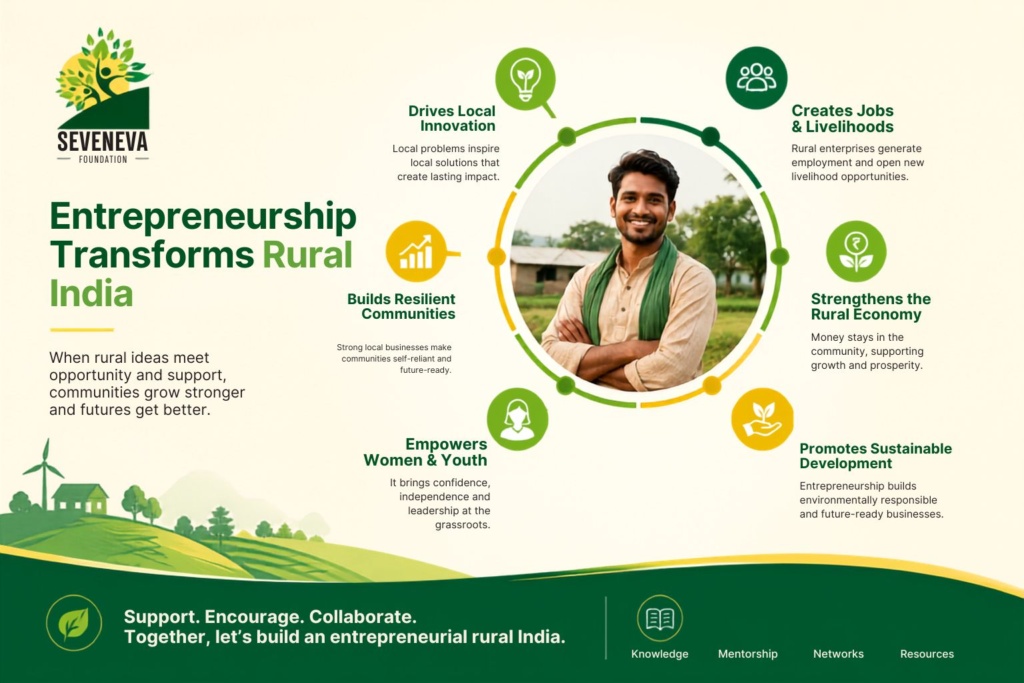
Entrepreneurship matters in rural India because it can expand economic opportunity in places where formal jobs, large employers and organized markets may be limited. When people are able to build viable local enterprises, they create more than personal income—they also contribute to a wider local economy.
One of the most direct benefits is job and livelihood creation. Even a small enterprise can create work for family members, local youth, service providers, transporters, suppliers or seasonal workers. As more enterprises emerge and grow, communities become less dependent on a narrow set of employment options.
Entrepreneurship can also help retain more economic value within rural areas. When agricultural produce, local materials or community skills are processed, packaged, serviced or marketed locally, a greater share of the value can remain closer to the people who created it. This is especially important in value chains where rural producers often sell raw products while most of the later value is created elsewhere.
Another advantage is income diversification. Rural households are often exposed to risks linked to weather, market prices, seasonal employment and agriculture. Additional enterprises—such as food processing, repair services, digital services, livestock-related businesses, retail, logistics or local manufacturing—can create alternative income sources and make household economies more resilient.
Entrepreneurship also strengthens the supporting ecosystem around other economic activities. A successful agricultural economy, for example, needs input suppliers, machinery services, storage, transportation, processing, finance, advisory services, packaging and market connections. Each of these needs can create opportunities for local entrepreneurs.
There is also a social dimension. When people see viable enterprises being built within their own communities, entrepreneurship becomes more visible and achievable. Local success can encourage others to develop skills, test ideas, seek mentorship and think differently about what is possible without necessarily leaving their communities.
However, enterprise creation should not be measured simply by the number of businesses started. The real goal is to build sustainable enterprises that solve genuine problems, reach customers and generate lasting value. Businesses that cannot find markets or operate profitably will not strengthen rural economies in the long term.
For this reason, rural entrepreneurship is most powerful when it is connected with skills, finance, technology, mentorship, infrastructure and access to markets. Entrepreneurship alone is not a complete rural development strategy, but it is an important economic pillar that can help communities create opportunities from within.
Turning Local Problems into Local Opportunities
Many strong businesses begin with a simple observation: something people need is missing, difficult to access, too expensive, unreliable or inefficient. In rural communities, these gaps can appear in agriculture, transportation, repair services, storage, healthcare, education, digital access, finance, market information and many other areas.
For an entrepreneur, a local problem is not automatically a business opportunity. The first step is to understand the problem properly. Who faces it? How often does it occur? What are people doing today to solve it? Are they willing and able to pay for a better solution? These questions help separate a genuine market need from an idea that may sound useful but has little real demand.
Consider a village where farmers regularly struggle to access machinery at the right time. One response might be a local equipment rental service. If producers lose value because they sell ungraded produce, there may be an opportunity in sorting, grading, packaging or aggregation. If young people travel long distances for basic digital services, a reliable local service centre could meet that need. In each case, the enterprise begins with a real, visible problem.
This problem-solving approach is important because rural entrepreneurship should not be based only on copying whatever business appears popular elsewhere. An enterprise is more likely to remain relevant when it is rooted in local conditions, available resources, customer behaviour and actual demand.
Innovation also does not always mean inventing new technology. Sometimes innovation is a better process, a more convenient service, improved packaging, a shared-use model, a new market connection or a different way of organizing an existing activity. A familiar business can become much more valuable when it solves a problem more effectively.
Local knowledge gives rural entrepreneurs an important advantage. People who live within a community often understand seasonal patterns, trust relationships, transport limitations, customer preferences and production challenges better than an outside business would. The challenge is to turn that understanding into a solution that is practical and financially sustainable.
A useful entrepreneurial question is therefore not simply, “What business should I start?” A better question is, “What important problem can I solve for a specific group of people, and can I build a viable model around that solution?”
When entrepreneurs begin with this mindset, local challenges can become starting points for new services, stronger value chains and enterprises that create both economic and community value.
Strengthening Agriculture Through Enterprise
Agriculture remains central to many rural economies, but the economic opportunity around agriculture is much larger than primary production alone. Farmers produce crops, milk, livestock, fruits, vegetables, spices and other commodities, yet much of the value is often created after the product leaves the farm.
This is where enterprise can strengthen agriculture. Rural entrepreneurs can build businesses around value addition, processing, storage, logistics, inputs, machinery, advisory services, technology and market access. These activities help connect production with higher-value markets and can create additional income opportunities across the agricultural value chain.
For example, a farmer or local enterprise may move from selling raw produce to cleaning, grading, processing, packaging or branding it. A group of producers may establish an aggregation and marketing service. A young entrepreneur may offer machinery rental, soil testing, drone services, digital advisory, cold-chain support or last-mile logistics. Each of these enterprises can solve a specific bottleneck that affects farm productivity, quality or market realization.
Value addition is especially important because raw agricultural products often have limited margins and short shelf lives. Processing and better post-harvest handling can improve usability, reduce losses and open access to different customer segments. However, value addition is not automatically profitable. Entrepreneurs still need to understand food safety, quality standards, packaging costs, customer demand, distribution and working capital before investing.
Agricultural enterprises can also improve access to services. Many small producers cannot individually purchase expensive equipment, specialized technology or professional advisory support. Shared-service models—such as custom hiring centres, equipment rental, common processing facilities or digital service platforms—can make these resources more accessible while creating viable enterprise opportunities.
Market linkage is another important area. Producing a good product is only part of the challenge; farmers and rural enterprises also need reliable buyers, market information, logistics, quality consistency and negotiation capability. Businesses that improve aggregation, traceability, branding, direct marketing or connections with institutional buyers can help reduce some of these gaps.
Technology can strengthen these models, but it should serve a clear purpose. Digital platforms, sensors, mobile applications, precision tools and data services are valuable when they help farmers make better decisions, reduce costs, improve quality or reach markets more effectively. Technology without a practical business case or user need is unlikely to create lasting impact.
The larger lesson is that agriculture should be viewed as an enterprise ecosystem, not only as farm production. Every stage—from inputs and cultivation to storage, processing, transport and marketing—contains needs that can become opportunities for capable entrepreneurs.
When more of these services and value-adding activities are developed closer to rural communities, agriculture can generate a wider range of livelihoods, stronger local businesses and more resilient rural economies.
Creating Opportunities for Rural Youth
Rural India has a large population of young people with growing aspirations, greater exposure to technology and a stronger desire for meaningful economic opportunities. Yet many rural youth still face a difficult choice: remain in their communities with limited career options, or migrate in search of work elsewhere.
Entrepreneurship can create another pathway. It allows young people to build opportunities around local needs, resources and emerging markets instead of depending entirely on formal employment. This does not mean every young person should start a business, but those with the interest and ability to do so should have a realistic route to experiment, learn and build.
Rural youth can be especially well placed to develop enterprises that combine local knowledge with digital tools and new business models. Opportunities may include agricultural services, food processing, e-commerce support, digital marketing, repair and maintenance, logistics, rural tourism, renewable-energy services, online education, data services and technology-enabled market access.
Technology is widening the range of possibilities. A young entrepreneur in a rural area can now communicate with customers, promote products, receive digital payments, access online training, use cloud-based tools and connect with suppliers or markets beyond the local area. These capabilities can reduce some traditional barriers of distance, although reliable connectivity, digital literacy and market understanding are still essential.
Young people can also bring a different approach to established rural businesses. A traditional enterprise may become more competitive through better branding, bookkeeping, customer service, packaging, online promotion or digital payments. Entrepreneurship therefore does not always require creating an entirely new industry; it can also mean modernizing and expanding existing economic activity.
However, enthusiasm alone is not enough. First-time entrepreneurs often need practical business skills, exposure to real markets, mentors, peer networks and small opportunities to test ideas before making major investments. Learning how to calculate costs, understand customers, manage cash flow, communicate value and adapt when an idea does not work is as important as technical knowledge.
This is why entrepreneurship education for rural youth should move beyond motivational messages. Young people need opportunities to identify problems, test solutions, interact with customers, develop prototypes or pilot services, and learn from actual business decisions. Practical experience can help them understand both the opportunities and the risks of enterprise.
The aim should not be to encourage migration or discourage it. Mobility will continue to be part of economic development. The stronger goal is to ensure that young people have genuine choices—including the possibility of building viable careers and enterprises within or connected to their own communities.
When rural youth can combine skills, technology, local understanding and access to supportive networks, they can become not only job seekers but also service providers, innovators, employers and contributors to stronger local economies.
Women as Rural Enterprise Leaders
Women already play a central role in rural economies through agriculture, livestock, household enterprises, food processing, crafts, self-help groups and community-based activities. Yet much of this economic contribution remains informal, under-recognized or disconnected from larger markets. Supporting women to move from participation to enterprise leadership can create significant economic and social value.
Women-led rural enterprises can strengthen household income, create local employment and diversify community livelihoods. They can emerge in areas such as food processing, tailoring, handicrafts, livestock-based products, retail, digital services, agricultural inputs, nurseries, local tourism, education services, wellness products and many other sectors.
The opportunity is not limited to very small businesses. With the right support, women entrepreneurs can build formal enterprises, develop brands, adopt technology, access wider markets and become employers. The real objective should therefore be to expand the scale, quality and sustainability of women-led enterprise—not simply increase the number of micro-activities.
However, women entrepreneurs often face barriers that go beyond business knowledge. These can include limited control over financial resources, restricted mobility, unpaid care responsibilities, weaker professional networks, limited exposure to markets and lower access to technology or formal institutions. These constraints can directly affect an entrepreneur’s ability to travel, negotiate, invest, take risks or grow a business.
This is why skills, finance, networks and market access need to work together. Training is useful, but training alone will not create a viable enterprise. A woman may learn food processing, for example, but still need help with product quality, licensing, packaging, pricing, digital payments, distribution, working capital and finding repeat customers.
Collective models can also be valuable. Self-help groups, producer groups, cooperatives and women-led enterprises can create shared access to equipment, procurement, branding, marketing and knowledge. These models can reduce individual risk, although they still require strong governance, clear responsibilities and market discipline to remain sustainable.
Digital tools can expand opportunities further. Smartphones, digital payments, social media, online marketplaces and simple business-management tools can help women reach customers, maintain records and participate in markets that were previously difficult to access. But access to technology must be matched by confidence, digital skills and practical support.
Women entrepreneurs also create visible local leadership. When a woman builds a successful enterprise, manages customers, creates jobs or leads a producer group, it can influence how economic roles are perceived within families and communities. This visibility can encourage other women and girls to consider entrepreneurship as a realistic pathway.
The goal should not be to treat women’s entrepreneurship as a separate or symbolic activity. It should be integrated into the wider rural entrepreneurship ecosystem with equal seriousness around business viability, technology, finance, mentorship, markets and growth.
When women are able to participate fully as enterprise owners and leaders, rural economies become more inclusive, more diverse and more capable of generating opportunity across the community.
Building Stronger and More Resilient Local Economies
A strong rural economy is not built around a single crop, employer or source of income. It is built through a network of farms, enterprises, services, institutions and local markets that support one another. Entrepreneurship can help create this network by adding more economic activities and strengthening the connections between them.
When local enterprises buy from nearby producers, hire local workers, use regional services and serve surrounding customers, more income circulates within the area. A food processor may buy from farmers, employ local staff, use transport services and purchase packaging. A machinery service may support multiple farms. A digital business may help local shops reach new customers. Each enterprise becomes part of a wider local economic system.
This matters because diversified local economies are generally better able to absorb shocks. If a community depends too heavily on one crop, one market or one form of seasonal work, a price fall, weather event or market disruption can affect many households at once. A broader mix of agricultural, service, processing, manufacturing and technology-enabled enterprises can create additional sources of income and employment.
Local enterprise development can also reduce unnecessary economic leakage. Rural communities often produce raw materials and purchase finished products or services from outside. Where it makes economic sense, building local capacity for processing, repair, storage, logistics, retail, professional services or other activities can help retain a larger share of value locally.
However, local economic development should not mean trying to produce everything within one community. Rural enterprises still need external markets, technology, investment, knowledge and partnerships. The goal is not economic isolation. It is to build stronger local capabilities while connecting communities more effectively with wider value chains and markets.
Resilience also depends on the quality of enterprises, not only their number. Businesses need customers, sound financial management, reliable supply chains and the ability to adapt. Enterprises that are poorly planned or dependent on temporary support may disappear quickly and create little long-term value.
This is why entrepreneurship works best when combined with infrastructure, skills, finance, digital connectivity, market access and supportive institutions. Together, these elements can create an environment in which local businesses are more likely to survive, grow and collaborate.
Over time, a healthy rural economy becomes less about isolated businesses and more about an ecosystem of interconnected opportunities. Farmers, entrepreneurs, workers, service providers, producer organizations, institutions and markets all contribute to the strength of the system.
Building this kind of local economy can give communities greater economic choice, improve their ability to respond to change and create more opportunities for people to build livelihoods close to where they live.
What Holds Rural Entrepreneurs Back?
Rural entrepreneurs often have ideas, local knowledge and the willingness to work, but good intentions alone do not remove the barriers that make enterprise difficult. Many promising ventures struggle not because the entrepreneur lacks effort, but because several constraints appear at the same time.
One major challenge is access to finance. New entrepreneurs may have limited collateral, irregular income histories or little experience dealing with formal lenders. Even when credit is available, the amount, timing or repayment structure may not match the needs of a young enterprise. At the same time, borrowing before validating demand can create unnecessary pressure. Finance is useful when it supports a sound business model, not when it substitutes for one.
A second barrier is practical business capability. Technical skill in farming, food processing, repair work or another activity does not automatically translate into the ability to price products, manage cash flow, keep records, negotiate with buyers, market effectively or plan for growth. These business-management gaps can become serious as an enterprise expands.
Market access is equally important. Entrepreneurs may be able to produce a good product or service but still struggle to reach enough customers, understand quality expectations, manage distribution or negotiate fair terms. Weak market connections can leave enterprises dependent on a small number of buyers or intermediaries.
Infrastructure also matters. Poor transport links, unreliable electricity, inadequate storage, weak internet connectivity or limited access to common facilities can increase costs and reduce competitiveness. Some of these challenges cannot be solved by an individual entrepreneur alone and require broader institutional or community-level investment.
Another common gap is mentorship and networks. First-generation entrepreneurs may not have family members or peers who have built businesses before. Without experienced guidance, it can be harder to evaluate risks, find suppliers, understand regulations, meet buyers or recover from early mistakes. Strong networks can reduce this isolation.
Technology can help, but access is uneven. Digital tools are most useful when entrepreneurs have the skills, connectivity and confidence to use them. Simply introducing an application or platform does not guarantee adoption or business improvement.
There are also social and personal barriers. Fear of failure, pressure to choose a conventional job, limited mobility, household responsibilities and lack of confidence can affect entrepreneurial decisions. These challenges can be especially significant for women and first-generation entrepreneurs.
The important lesson is that rural entrepreneurship should not be treated as a matter of motivation alone. Telling people to “become entrepreneurs” without addressing skills, finance, markets, infrastructure, technology and support networks can lead to frustration rather than sustainable enterprise creation.
A stronger approach is to reduce these barriers systematically so that capable entrepreneurs have a realistic chance to test, build and grow viable businesses.
What an Enabling Rural Entrepreneurship Ecosystem Looks Like
A strong entrepreneur can still struggle when the surrounding system is weak. Rural entrepreneurship grows more sustainably when individuals are supported by an ecosystem that helps them learn, test ideas, access resources, reach markets and recover from early mistakes.
The first requirement is practical education and skill development. Aspiring entrepreneurs need more than motivational sessions. They need to understand customers, pricing, costs, cash flow, marketing, digital tools, compliance and day-to-day business management. Training becomes more useful when it is connected with real enterprises, local examples and hands-on problem solving.
The second requirement is mentorship and incubation support. First-time entrepreneurs often do not know which decisions matter most in the early stages. Access to experienced mentors, sector experts, peer networks and incubation support can help them validate ideas, avoid common mistakes and build stronger business models before making large investments.
The third requirement is appropriate finance. Different enterprises need different forms of capital. Some may start with savings or small loans, while others may require working capital, equipment finance, grants for prototyping or investment for growth. Access to finance is most useful when it is matched with financial literacy, realistic business planning and repayment capacity.
Technology is another important part of the ecosystem. Digital payments, online marketplaces, bookkeeping tools, communication platforms and sector-specific technologies can improve efficiency and market access. But technology support should focus on practical adoption rather than simply introducing new tools.
Entrepreneurs also need stronger market connections. Training someone to produce a product without helping them understand customers, quality standards, distribution, competition and pricing leaves a major gap. Market exposure, buyer connections, aggregation networks, branding support and access to digital channels can help enterprises move from production to actual sales.
Infrastructure matters as well. Reliable roads, electricity, internet connectivity, storage, transport, common facilities and local service centres can significantly affect the viability of rural businesses. Some enterprise challenges cannot be solved by the entrepreneur alone and require investment or coordination by institutions.
Finally, supportive ecosystems depend on partnerships. Local governments, financial institutions, universities, incubation centres, industry, civil-society organizations, FPOs and community institutions can each contribute different resources and expertise. The most effective systems connect these actors around the real needs of entrepreneurs rather than operating in isolation.
An enabling ecosystem does not guarantee that every enterprise will succeed. Business always involves uncertainty. Its purpose is to give capable entrepreneurs a fairer opportunity to test, learn, adapt and grow.
For rural entrepreneurship in India to create lasting economic value, the focus must therefore move beyond encouraging people to start businesses. The larger task is to build local systems that can consistently turn ideas, skills and opportunities into sustainable enterprises.
From Enterprise to Community Impact
A successful rural enterprise creates value first by serving customers and sustaining itself financially. But when that enterprise is rooted in a local community, its impact can extend well beyond the business owner.
The most visible effect is often employment and income generation. A growing enterprise may hire local workers, purchase from nearby suppliers, engage transporters, use local services or create opportunities for other small businesses around it. Even when the business remains modest in size, these linkages can contribute to a wider livelihood ecosystem.
Enterprises can also strengthen local confidence and aspiration. When people see businesses being built successfully within their own communities, entrepreneurship becomes more tangible. Young people may begin to see local opportunity differently, families may become more open to enterprise as a career path, and other potential entrepreneurs may be encouraged to test their own ideas.
Another important impact is the development of local capabilities. Enterprises create demand for skills such as bookkeeping, digital marketing, packaging, quality management, machine operation, customer service and logistics. Over time, these capabilities can spread through workers, suppliers, partners and peer networks, making the local economy more capable of supporting future businesses.
Rural enterprises can also contribute to innovation and problem-solving. Businesses that respond to gaps in agriculture, services, market access, technology or infrastructure often develop practical solutions suited to local conditions. When these solutions work, they can be adapted or replicated by other communities and entrepreneurs.
The wider community benefits are strongest when enterprises are inclusive and connected with local value chains. A food-processing business that sources from nearby farmers, for example, can create value at several levels: better market access for producers, jobs in processing and packaging, work for transporters, and new products for consumers. The impact comes from the relationships surrounding the enterprise, not only from its own revenue.
This is why entrepreneurship should be viewed as part of a broader development system. Education builds knowledge, skills improve capability, finance enables investment, technology expands possibilities, markets create demand, and networks connect people with opportunities. Enterprise becomes one mechanism through which these different elements can translate into livelihoods and local economic activity.
For institutions working in rural development, the objective should therefore not be to create dependency on programmes. It should be to help people and communities develop the capabilities, connections and confidence needed to build sustainable opportunities of their own.
When viable enterprises grow alongside stronger skills, networks and local institutions, the result can be more than business creation. It can contribute to jobs, livelihoods, innovation, participation and long-term community development.
The strongest form of rural entrepreneurship is therefore not enterprise in isolation. It is enterprise that becomes part of a healthy local ecosystem and creates value that reaches beyond the entrepreneur.
Conclusion: Building Opportunity Where People Live
Rural development is often discussed in terms of infrastructure, agriculture, employment and public services. All of these matter. But lasting economic progress also depends on whether people can create opportunities for themselves and others within the places they call home.
That is why rural entrepreneurship in India deserves attention as an important part of the development landscape. A strong rural economy needs more than job seekers; it also needs problem-solvers, producers, service providers, innovators and enterprise builders who can respond to local needs and connect communities with wider markets.
The goal should not be to turn everyone into an entrepreneur. Entrepreneurship involves uncertainty, risk and responsibility, and it is not the right path for every person. The goal is to ensure that those who do want to build enterprises are not held back simply because they lack access to skills, finance, mentorship, technology, networks or markets.
When the right support systems are in place, rural enterprises can create employment, strengthen agriculture, open opportunities for youth and women, add value to local resources and make communities more economically resilient. Their impact can extend far beyond the individual business owner.
The most promising approach is therefore to think in terms of ecosystems rather than isolated entrepreneurs. Education, incubation, finance, infrastructure, market access, digital tools, institutions and community networks need to work together so that good ideas have a better chance of becoming sustainable enterprises.
For rural youth and aspiring entrepreneurs, the starting point is often simple: look closely at the problems around you, understand who faces them, test whether a better solution is needed and begin small enough to learn before scaling. For institutions and development organizations, the responsibility is to make that journey more practical, connected and accessible.
Building stronger rural economies will require many different pathways. Entrepreneurship is one of them—and when it is grounded in real needs, supported by the right ecosystem and connected to markets, it can help create something especially valuable: opportunity where people already live.
Read More
Want to explore the broader vision for stronger rural communities, livelihoods and local opportunity? Read Empowering Rural India to learn how Seveneva Foundation approaches rural development through empowerment, enterprise and sustainable community progress.
Umakanta Giri, a growth marketer and social entrepreneur, is helping transform rural communities through empowerment and sustainable practices. By supporting self-reliance, caring for the environment, and boosting local economies, he’s building thriving communities where both people and nature can grow. 🌱
About us and this blog
SEVENEVA: Guiding Sustainable Progress with 7E Principles and Value Addition.
Reach out
More from our blog
See all posts



Recent Posts
- Rural Entrepreneurship in India: Why It Matters August 16, 2026
- Traditional Farming Practices in India: Ancient Lessons for Today September 26, 2025
- Smart Farming for Small Farmers: Simple Tools September 13, 2025
